
Sufficient Beats Better Every Time
AI Just Made It Faster.

Melissa M. Reeve wrote something last week that stopped me mid-scroll. She laid out the data on what happened to professional photographers when smartphones arrived. Camera shipments down 94% in a decade, the collapse of the working studio photographer, and what that pattern means for engineers watching coding models arrive right now.
She has the numbers. I have the scars.
Because I was the photographer. In the mid-2000s, I ran a sports photography franchise as a side business. Youth sports. The kind of thing where parents line up after the game, flip through proofs, and order prints. We had the equipment, the workflow, the turnaround. It was a real business.
And then parents started showing up with prosumer cameras and then phones.
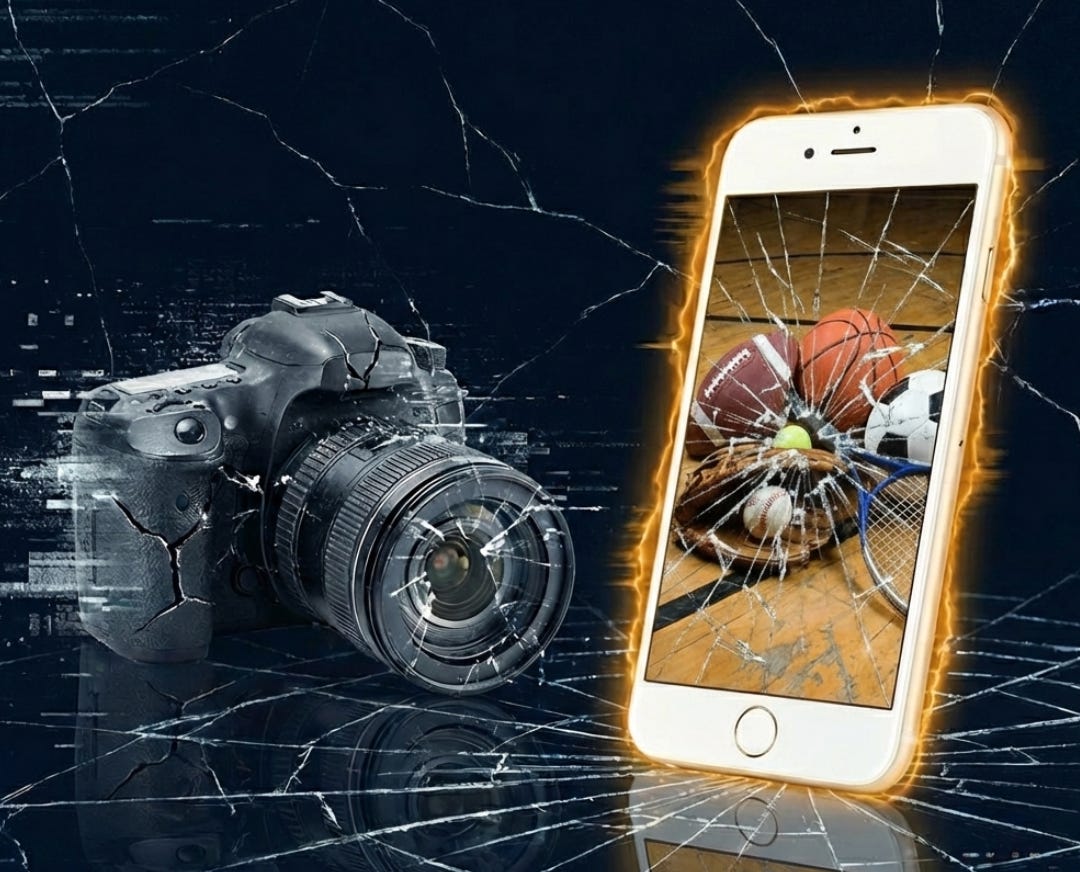
Not professionals. Not people who understood aperture or shutter speed or how to freeze a kid mid-swing at a baseball game. Just parents. With cameras getting shots that were, if I’m being honest, pretty good. Not technically superior. Not artistically interesting. But sufficient. Good enough for the Facebook album. Good enough that the friction of ordering from us started to outweigh the marginal quality difference.
The business started sliding. We saw it happening in real time and couldn’t stop it.
What I didn’t fully understand then, and what I’ve come to recognize as a pattern, is that “sufficient” is always the disruption. Not “better.” Sufficient.
I’ve seen this pattern before.
QuickTime VR Required Real Technical Skill. Then It Didn’t.
Around 1996, I was working with QuickTime VR—Apple’s technology for creating interactive panoramic images you could drag around and explore. To make one, you shot overlapping images on a tripod, stitched them via command line, exported a proprietary file format, and required visitors to install a browser plugin to view it. Genuinely technical work.Today, you swipe right on your iPhone. Done.
I built the first websites I ever built line by line, in a text editor. No libraries. No CSS (CSS didn’t exist yet, not in any practical sense!) Every layout was a hack. Every table-based design was a minor engineering feat. That knowledge was valuable.
Then came frameworks. Then templates. Drag-and-drop builders. Now AI that writes the HTML for you.
I learned Photoshop when everything was manual. Feathered selections. Hand-painted drop shadows. Clipping paths carved by hand around complex objects. Skilled work. The kind of thing that took years to get fast at.
Now you press and hold on an iPhone and it separates the subject from the background in under a second.
I learned darkroom photography. F-stops, aperture, film speed, chemical development. A real craft. A real skill. A real economic asset.
Now the phone does it all, and the photos are, honestly, often better.
Each time one of these shifts happened, there was a moment where I’d think: that’s not as good as what I can do. And I was right. It wasn’t. But then I watched the clients, the customers, the parents on the sideline, and I realized they’d stopped caring about the gap.
The sufficient thing is sufficient. And the game changes.
This is That Moment (Again!)
Which brings me to where we are right now.
I’m not writing code eight hours a day, but I’ve shipped AI products. I’ve integrated systems. I’ve sat in enough engineering conversations to have a feel for the texture of the work and what it actually requires. And when I look at what these models are starting to do, end-to-end task completion, not just autocomplete but actual reasoning through a problem and producing working code, I feel the same thing I felt when the parents showed up at the soccer field with iPhones.
Oh. This is that moment.
Not because the models are better than skilled engineers. They’re not. Not even close, for complex systems work, for architecture decisions, for the kind of judgment that comes from having shipped and broken things at scale.
But for a growing category of tasks? They’re sufficient. And sufficient, as I’ve learned, is the whole game.
Here’s what gets missed in most of the conversation about this.
Melissa makes the point well. Annie Leibovitz isn’t losing sleep over the iPhone 17. The high end survives. The commodity middle gets hollowed out.
But there’s a third thing that happens that doesn’t get talked about enough: the floor rises.
When technical skills are abstracted, the baseline goes up
You don’t need to know HTML to have an opinion about web design anymore because you’ve used enough websites to have taste. You don’t need darkroom chemistry to take a good photo. The phone handles the exposure, and now everyone has enough visual literacy to know what they like. The abstraction democratizes access to the output, which means the conversation shifts from “can you produce this” to “do you have judgment about what’s worth producing.”
The skill doesn’t disappear. It relocates.
When Photoshop eliminated hand-painted drop shadows, it didn’t eliminate the need for design judgment. It moved the scarce resource up the stack, from technical execution to creative direction. The people who survived and thrived weren’t the ones who were fastest at the manual technique. They were the ones who had developed taste and judgment that the tool couldn’t replicate.
The question for anyone in or adjacent to software right now isn’t “will this replace me.” It’s the same question the best photographers asked when iPhones arrived: what part of what I do is judgment, and what part is execution?
The execution is coming for a lot of people. The judgment is what remains. That’s the new playbook.