
AI is the new OS — but marketers’ curiosity will decide its value
At HubSpot's Inbound, the talk of AI was everywhere, but the brands that thrive will balance AI tools with curiosity-driven strategies.

Editor’s note: This was previously posted on MarTech.org and includes minor edits, additions and notes.
AI hype is following a well-worn path. During the dot-com boom, we were promised the internet would bring an overnight revolution. While it was revolutionary, some changes arrived quickly, but most unfolded over years, marked as much by failures and false starts as by lasting breakthroughs.
I was at Inbound 25 in San Francisco this September, and the AI hype was overwhelming. Conversations were either focused solely on the tactical use of AI or, interestingly, on reframing AI in our minds.
AI as the new OS
AI is quickly becoming the infrastructure layer of modern business.
In his keynote, Dario Amodei, CEO of Anthropic, called it an operating system, much like cloud computing. Adoption isn’t theoretical anymore. Usage is widespread across roles and industries. In pharma, legal, and manufacturing, AI reduces friction at a scale humans can’t match. For example, innovative manufacturers now use AI to detect user context to serve different experiences automatically and are accelerating their use of AI to mine for insights.
Claude and other assistants are already reshaping organizational productivity, accelerating code and content creation through automated drafting and suggestions. But lessons from the past ring loudly in my memory. Not every shiny demo is ready for prime time.
How many incredible demos and keynotes have resulted in less-than-stellar real-world applications and features?
An OS must be reliable before it can be transformative.
Curiosity makes AI valuable
AI is powerful, but curiosity makes it valuable. AI provides scale, but curiosity provides depth.
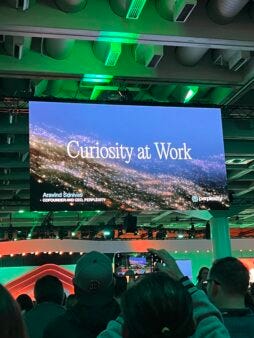
Aravind Srinivas, CEO of Perplexity, reminded us that progress often begins with the questions nobody dares to ask. Eric Bailey, president of Bailey Strategic Innovation Group, pushed further, showing how our brains trick us with certainty when what we need instead is professional not-knowing, a disciplined willingness to lead through inquiry rather than assumption. Beth Dunn, head of product experience at Agent.ai (a network for AI Agents), reframed curiosity as an act of empathy, a way of listening that deepens connection.
Curiosity isn’t just a trait. It’s the basis for learning, trust and innovation.
Human truths and creative courage
Curiosity isn’t abstract. It shows up in how teams handle fear, failure, and resistance.
Amy Poehler talked about thanking fear before moving past it in her closing keynote. Failure, she argued, isn’t just a setback. It creates the conditions that make learning possible. The best teams value big swings over safe bets.
In my Colab sessions called “Stop Fighting Resistance—Start Using It,” I saw curiosity helping groups overcome resistance and build momentum. One attendee worked through a simple framework that enabled her to reframe her resistance to updating old website content. Another realized their resistance was coming from something unrelated to work, and reframing the issue led to a breakthrough in thinking.
Without curiosity, AI is a stochastic parrot. All it can do is find the most likely used word, number, or color for a particular situation.
A necessary caution
AI alone produces speed without meaning, and curiosity alone generates meaning without momentum. Many leaders will default to automation or reflection for various reasons:
FOMO (fear of missing out on AI),
Pressure from management/board to do something rather than nothing,
Personal comfort, and/or
Skill gaps in talent.
Any or all of those leave value on the table or lead to missed opportunities. AI without curiosity leads to irrelevant noise, and curiosity without AI leads to brilliant ideas that never scale.
Senior marketers are told to move fast, automate and scale. But speed without depth is empty. Curiosity makes scale meaningful. The companies that thrive won’t be the ones that adopt every AI tool. They’ll be the ones that design for both: optimizing stacks for efficiency while cultivating cultures that reward curiosity.
Recommendations for senior marketers
Pair efficiency with inquiry: Build AI and automation roadmaps alongside a portfolio of open questions teams are expected to explore. Think brainstorming sessions, shared collaboration tools, and hackathons.
Redefine KPIs and reward curiosity: Balance throughput and engagement metrics with learning metrics such as new customer insights surfaced or hypotheses tested. Make experimentation and asking hard questions part of performance reviews. Consider a “failed experiment count,” or shared prompt libraries and examples.
Design for identity and reliability: Treat AI as infrastructure and avoid scaling unstable tools. Shift from channel hacks to identity-aware strategies, using what you know about individuals to shape communication and trust. One way to achieve this is to shift focus from constantly seeking new tools to building shared momentum and language around a set of standardized platforms. You should choose these platforms for their ability to allow for personalization and customization.
Around the town, notes and musings:
If you are in the Raleigh/Durham area on September 16th, I’m rebooting my Inbound Colab session at the TechSEO meetup. You should totally come and throw tomatoes.
The Noles go undefeated to 2-10 last season and are smack back in the top 10. Miley had it right with “The Climb.” #GoNoles.
Are you into meditation, philosophy, and meeting cool people? My meditation app of choice is Waking Up (thanks, Sam Harris!), and as it turns out, the team also built a community that has local meetups. This past Sunday, I ventured out and met a few terrific folks for a talk about mediation, mindfulness, football, and more. We agreed that it’s helpful to ask yourself, “Is this real?” when faced with challenging situations. It’s helpful to check your own mind and not get caught up in anxieties if at all possible. Sometimes it’s not possible, and that’s okay too.